What an AI calling rate in India actually includes
A useful AI calling comparison looks beyond a headline rate and examines the service, billing rules and business workflow behind every conversation.
AI calling uses conversational artificial intelligence to answer or place calls, respond to common questions, collect information and guide customers towards a suitable next step. Businesses use it for sales follow-ups, enquiry handling, appointment confirmations, reminders and customer support.
When evaluating AI calling services in India, first identify the billing unit, then determine what is included in the service. Some solutions combine conversational AI and telephony into one service, while others may separate these components. The same label can therefore describe different operating models.
AI calling is a business workflow, not just a phone call.
The complete process may include a conversation, qualification questions, customer-data capture, call routing, CRM updates and a follow-up message.
Comparison principle: Evaluate providers using the same scenario, call duration, required features and assumptions. Otherwise, a comparison may look precise while measuring different services. There are fuller answers to the common pricing questions in the AI calling pricing FAQ.
Why AI calling services matter for Indian businesses
Businesses that receive enquiries from websites, advertising campaigns, marketplaces and telephone calls often need to respond through several channels. Manual follow-up can become difficult when enquiries arrive outside working hours, sales teams cover multiple regions or customers prefer different languages.
AI Calling Agents can handle suitable recurring conversations and collect information before passing qualified or complex enquiries to employees. This gives sales and support teams a more structured way to manage repeated questions while preserving a human route for conversations that need individual attention.
Respond to enquiries
Answer common questions, explain products or services, capture requirements and direct customers to the next step.
Follow up consistently
Support new-lead callbacks, missed-call follow-ups, appointment confirmations and customer re-engagement.
Collect useful information
Record details such as customer needs, preferred location, budget, timeline and lead source where relevant.
Connect the next action
Route calls, send configured WhatsApp follow-ups or move lead information into an appropriate business workflow.
From individual calls to a repeatable process
The value of automation depends on how well the call connects to the wider customer journey. A property enquiry may need a site-visit booking, while a manufacturing enquiry may require product specifications and distributor details. Define that outcome before comparing services.
AI calling features to compare before choosing a provider
AI calling providers differ in how they manage conversation flow, customer context and actions after a call. Start by separating essential requirements from features that are useful only for particular workflows. This helps avoid selecting a solution that sounds capable but cannot complete the task your team actually needs.
Inbound and outbound calling
Inbound agents can answer calls, share information, handle FAQs, collect customer details and transfer conversations to employees. Outbound agents can follow up on enquiries, contact missed-call leads, confirm appointments and support reminder campaigns. Confirm that the service supports your intended calling workflow.
Conversational quality and language support
Test the agent with realistic questions, interruptions, regional expressions and unfamiliar product terms. For Indian audiences, language selection matters. Troika Tech's AI agents support English, Hindi, Marathi, Gujarati, Tamil, Telugu and Bengali. Businesses should test their own scenarios rather than assume that language availability guarantees a suitable customer experience.
Lead capture, routing and integrations
Check whether the system captures the fields your team needs, routes calls according to customer intent and supports CRM lead capture. If your workflow includes WhatsApp, confirm which messages or documents can be shared and what triggers them. Also establish what happens when the agent cannot answer a question or the customer requests a person. High-volume campaigns are priced differently again — see bulk AI call rates in India.
Feature checklist for an AI calling evaluation
- ✓Inbound and outbound calling support
- ✓Custom greetings and conversation scripts
- ✓Lead qualification and structured data capture
- ✓Intent-based routing and human transfer
- ✓Language and accent suitability
- ✓CRM and messaging workflow support
- ✓Conversation monitoring and reporting
- ✓Clear data-handling and escalation rules
AI calling service comparison by billing and capability
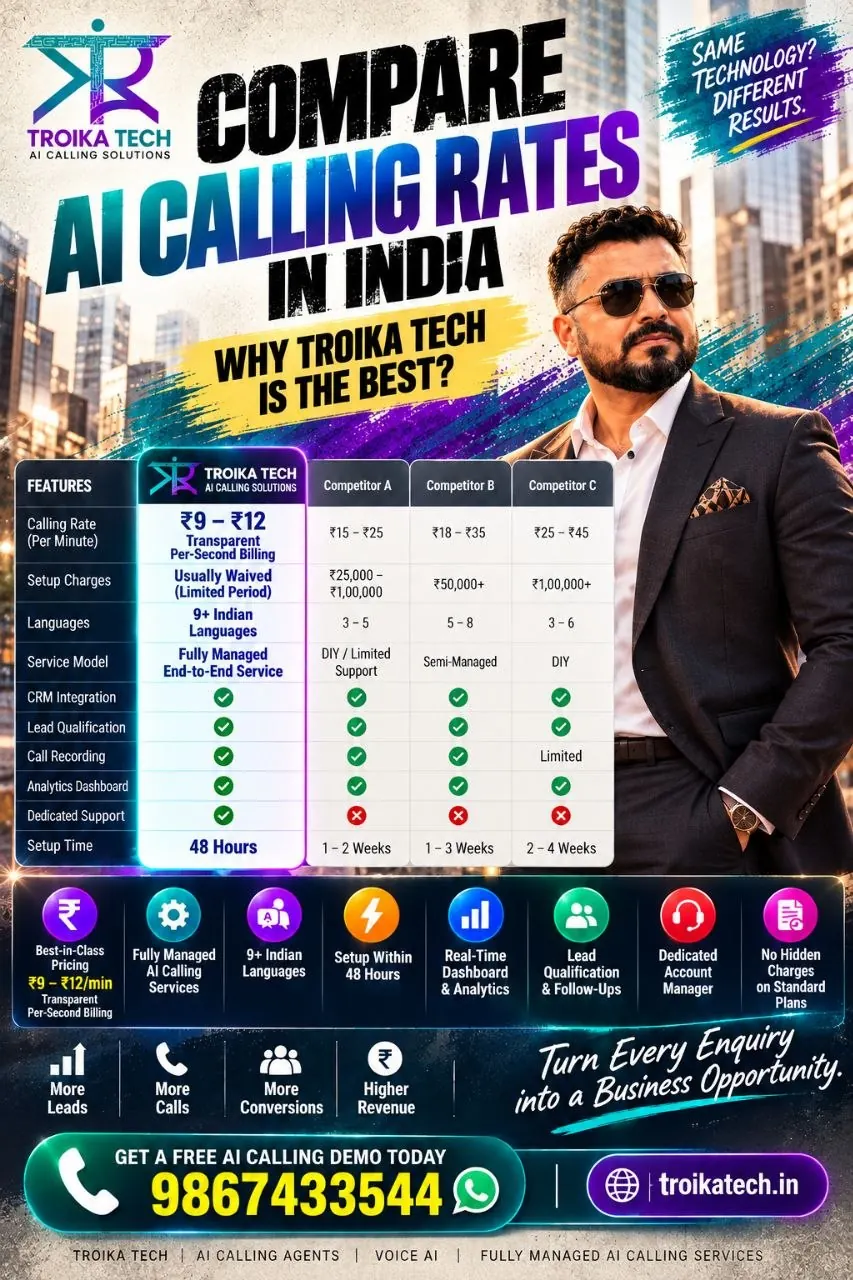
AI calling rates compared, provider by provider
| Feature | Troika Tech | Provider A | Provider B | Provider C |
|---|---|---|---|---|
| Calling rate (per minute) | ₹9 – ₹12 per-second billing | ₹15 – ₹25 | ₹18 – ₹35 | ₹25 – ₹45 |
| Setup charges | Usually waived limited period | ₹25,000 – ₹1,00,000 | ₹50,000+ | ₹1,00,000+ |
| Indian languages | 9+ | 3 – 5 | 5 – 8 | 3 – 6 |
| Service model | Fully managed, end to end | DIY / limited support | Semi-managed | DIY |
| CRM integration | ✓ | ✓ | ✓ | ✓ |
| Lead qualification | ✓ | ✓ | ✓ | ✓ |
| Call recording | ✓ | ✓ | ✓ | Limited |
| Analytics dashboard | ✓ | ✓ | ✓ | ✓ |
| Dedicated support | ✓ | ✗ | ✗ | ✗ |
| Setup time | 48 hours | 1 – 2 weeks | 1 – 3 weeks | 2 – 4 weeks |
Provider A, B and C represent rates quoted in the Indian market at the time of writing and are not named companies. Published pricing changes, so confirm current rates with any provider before deciding.
Before comparing providers, use a consistent evaluation sheet. The table below compares common service models and the questions a business should resolve. It is a framework for evaluating actual provider offers, not a live directory of provider rates or a claim that every service includes the listed capabilities.
| Comparison area | What to check | Why it matters |
|---|---|---|
| Billing unit | Per second, per minute, connected duration or another usage rule | Determines how usage is recorded and interpreted. |
| Call treatment | Connected calls, unanswered attempts, short calls and transfers | Clarifies which events count as billable usage. |
| Service inclusions | AI conversation, telephony, voice options and reporting | Shows which capabilities are included and which are separate. |
| Integrations | CRM, WhatsApp, calendar and lead-capture workflows | Helps prevent disconnected customer follow-ups. |
| Implementation | Configuration, scripts, testing and integration requirements | Establishes what is needed before the workflow goes live. |
| Oversight | Conversation review, escalation and operational monitoring | Supports quality control and human intervention. |
| Compliance | Consent, calling rules, data handling and relevant telecom requirements | Helps ensure the workflow is appropriate for its market. |
Provider-specific rates and service inclusions must be verified against current official documentation. Do not treat an unverified figure or a general market estimate as a confirmed offer.
Per-second versus per-minute billing
Per-second billing measures usage in smaller time increments, while per-minute billing may count a full minute or use another stated rounding rule. The actual effect depends on the provider's terms, minimum billable duration and treatment of each call. Ask for a written example using the same call pattern before comparing the billing models.
Separate platform and telephony components
Some service arrangements may combine components, while others may distinguish AI processing, telephone connectivity, number services and additional capabilities. Confirm what is included, how usage is measured and whether taxes or other applicable charges are treated separately. Use only verified information in the final comparison.
How AI calling works from requirements to deployment
A reliable implementation begins with the business outcome, not the voice or technology alone. Define what the agent should achieve, which information it must collect, what it may communicate and when it must involve a person. These decisions guide configuration, testing and ongoing improvement.
Define
Choose the use case, audience, call direction and desired outcome.
Configure
Prepare scripts, questions, language settings and escalation rules.
Test
Validate realistic calls, captured data, routing and follow-ups.
Deploy
Launch the approved workflow, monitor conversations and refine it.
Prepare realistic test conversations
Test common questions, unclear responses, customer objections, interruptions and requests to speak to a person. Check whether the agent collects accurate details and follows the correct next step. For a lead-generation workflow, test the path from the first call to the CRM record and any configured follow-up message.
Plan for human oversight
Not every customer interaction should be handled entirely by automation. Set rules for complaints, complex questions, uncertain answers and sensitive situations. Review how the system handles these cases, and define who is responsible for follow-up. Troika Tech supports call transfers to team members and offers an AI-powered dashboard for managing agents, leads and conversations.
How to choose the right AI calling solution
The right service depends on the customer interactions your business wants to automate and the systems that must work alongside it. A business making appointment confirmations has different requirements from a sales team qualifying complex industrial enquiries. Define a short list of essential capabilities and test each one against a representative scenario.
Match the service to the workflow
For simple reminders, clear scripts and dependable scheduling may be central requirements. For lead qualification, the agent may need to ask follow-up questions, capture structured information, handle objections and route the conversation based on intent. For customer support, escalation and accurate answers may matter more than outbound campaign features.
Check the whole customer journey
Assess how the agent receives customer information, how it records a conversation and what happens after the call ends. Where appropriate, confirm whether it can share brochures or other approved material through WhatsApp, create CRM records or support calendar-based bookings. Validate each integration rather than assuming that a channel being listed means every workflow is available.
Operational fit
The agent follows the process your team uses, collects relevant details and knows when to hand a conversation over.
Customer experience
Conversations use suitable language, clear responses and appropriate next steps instead of forcing every caller through the same script.
Clear oversight
Your team can monitor the workflow, review conversations and adjust scripts when requirements change.
Verify compliance before launch
Businesses should confirm the telecom, consent, privacy and data-handling requirements that apply to their campaigns and customer locations. For India, verify the relevant TRAI, DLT and other applicable requirements for the intended calling use case. Requirements can differ according to campaign purpose and implementation, so seek appropriate guidance where necessary. For smaller teams we work through the same arithmetic in cost of AI calling for small businesses.
AI calling use cases for Indian and global businesses
AI calling is most useful when a business has recurring conversations with a clear purpose. Industry-specific workflows help the agent ask relevant questions, capture useful information and send customers towards the correct next action. The same underlying capabilities can serve different markets when the language, process and compliance requirements are configured appropriately.
Real estate
Qualify property enquiries, share project details and arrange site visits.
Education
Answer course questions, explain admission steps and support follow-ups.
Manufacturing
Collect product requirements, answer specification queries and route distributor leads.
Retail and e-commerce
Support order-related enquiries, reminders and customer re-engagement.
Healthcare
Assist with appointment scheduling and routine availability enquiries.
Logistics
Handle suitable delivery updates and direct enquiries to relevant teams.
Support regional and distributed sales teams
Indian organisations may serve several states with different language preferences, while international businesses may coordinate teams across markets and time zones. Multilingual support, clear lead records and consistent routing can help maintain a repeatable process across locations. Each market still needs appropriate language testing and local compliance checks.
Connect calls with messaging and customer records
Telephone conversations do not always complete the customer journey. A caller may need a product brochure, a location map or a written follow-up after speaking with an agent. Where supported and configured, connecting AI calling with WhatsApp and CRM workflows helps move the enquiry forward and gives employees relevant context for the next interaction.
Benefits of AI calling for lead management and customer service
AI calling can make recurring communication more structured by applying consistent scripts, collecting defined information and triggering follow-up actions. The result depends on the quality of the implementation, the suitability of the use case and how the organisation manages exceptions. Establish clear operational measures before launch so the team can assess whether the workflow is doing its intended job.
Consistent follow-up
Automated workflows can support new enquiries, missed-call callbacks, appointment reminders and re-engagement. Defined rules make it easier to decide when an interaction should occur and what the agent should do when the customer responds.
Structured lead qualification
An agent can collect details such as the customer's requirement, preferred location, budget, timeline and lead source. Sales representatives can then use those details to understand the enquiry before continuing the conversation. The required fields should be limited to information that is useful for the business purpose.
More accessible customer communication
Agents available around the clock can handle suitable conversations beyond normal office hours. Multilingual support may also help businesses communicate with customers who prefer regional languages. These capabilities should complement appropriate human support rather than replace it in every situation.
Clearer operational visibility
Monitoring leads and conversations helps teams identify incomplete records, recurring questions and points where customers need assistance. Use these observations to improve scripts, refine routing and adjust the handover process. Avoid relying on a single headline metric without understanding the quality of the interactions behind it.
Practical measure: Track whether the agent completes the intended task, captures accurate information, follows the correct escalation rule and supports the next step in the customer journey.
Frequently asked questions about AI calling in India
These answers cover common questions about AI calling, service comparisons, implementation and business suitability. Confirm provider-specific capabilities and current terms directly before making an operational decision.
Comparing AI calling rates in India means evaluating billing methods, service inclusions and operational capabilities across automated calling solutions. A useful comparison examines usage measurement, call handling, language support, integrations, lead capture and human handover options.
AI calling uses conversational artificial intelligence to handle inbound or outbound telephone interactions. An AI Calling Agent can answer questions, share product information, collect customer details, qualify leads and trigger follow-up actions based on the conversation.
AI calling can support real estate companies, educational institutions, manufacturers, retailers, healthcare providers, automobile dealers, logistics businesses and other organisations that handle recurring customer conversations. The workflow should be adapted to each industry's customer requirements and operating procedures.
AI calling can help businesses handle recurring enquiries, maintain communication outside normal office hours and follow up with leads more consistently. It can also capture customer details, route conversations according to intent and reduce the need for employees to repeat routine information.
AI calling can support new enquiry follow-ups, missed-call callbacks, appointment confirmations, payment reminders, cold-lead follow-ups and customer re-engagement. Inbound agents can answer frequently asked questions, collect requirements, share product information and transfer calls when human assistance is needed.
Implementation typically starts with defining the use case, conversation script, required customer information and escalation rules. The provider then configures the agent, connects relevant workflows where supported, and tests representative conversations before deployment. The timeline depends on workflow complexity, integrations and testing requirements.
AI calling can support businesses serving Indian and international customers, provided the service meets their language, telephony and regulatory requirements. Businesses should confirm applicable calling rules, consent requirements and data-handling obligations before launching a campaign.
Troika Tech provides inbound and outbound AI Calling Agents designed to support sales, customer service and lead engagement. Its capabilities include multilingual conversations, personalised scripts, lead-data collection, intent-based call routing, optional human transfers and WhatsApp follow-ups.
Troika Tech AI Calling Agents for business communication
Troika Tech provides AI Calling Agents for inbound and outbound communication, supporting sales, customer service and lead engagement. Businesses can configure calling workflows for enquiries, follow-ups, reminders and re-engagement, with conversations adapted to their requirements.
Calling capabilities connected to next steps
Troika Tech's AI Calling Agents can answer common questions, share product information, capture customer details and optionally transfer calls to team members. Outbound workflows can support new enquiry follow-ups, missed calls, appointment confirmations and payment reminders. The agents can also use personalised scripts, handle objections and route calls according to intent.
Multilingual and connected workflows
Troika Tech's AI agents support English, Hindi, Marathi, Gujarati, Tamil, Telugu and Bengali. Calling workflows can also include WhatsApp follow-ups, such as sharing brochures, photographs and location maps, where configured. CRM lead capture helps move customer details into the sales process.
Monitoring and human oversight
An AI-powered dashboard supports monitoring and management of agents, leads and conversations. Businesses can use this visibility to review the workflow and determine where scripts, escalation rules or handovers need attention. Troika Tech's approach, “AI Created. Human Perfected.”, reflects its focus on combining AI capabilities with human oversight.
Before choosing a workflow: Define the calls you want to automate, the information you need to capture, the languages your customers use and the situations that require a human employee. These requirements create a clear starting point for implementation.
Find the right AI calling workflow for your business
When you compare AI calling rates in India, evaluate the complete service alongside its billing rules, conversation quality, language capabilities, integrations and operational fit. A well-defined workflow can help your team manage enquiries, qualify leads and maintain consistent customer communication.
Explore Troika Tech's AI Calling Agent capabilities and discuss your business requirements to identify a suitable approach for inbound calls, outbound campaigns, lead management and customer follow-ups. You can also watch a AI calling agent on a live call or AI agent qualifying a lead.
Review the comparison guide