Why AI calling fits pre-launch and EOI campaigns
As of 7 October 2026, the next major Indian festive sales window is approaching. Dussehra is on 20 October 2026 and Diwali Lakshmi Puja falls on 8 November 2026 in Mumbai.
That makes October–November a useful planning period for businesses preparing launches, festive offers or property pre-launch campaigns. The same operating method can work for a residential builder's sales office in Mumbai, a jewellery shop in Ahmedabad collecting festive enquiries, or an Indian grocery business in New Jersey running a new-store or seasonal promotion.
The practical rule: the first call should not try to close the sale. It should establish relevance, collect the minimum useful information and decide what happens next.
Lead
Capture the enquiry and trigger the first qualification step.
Qualify
Ask about need, budget, timeline, language and buying purpose.
Prioritise
Classify the prospect as Hot, Warm, Nurture or Not-fit.
Handoff
Give the human team the right context and next action.
The AI calling playbook for a pre-launch campaign
Prepare the qualification questions before buying traffic.
Write down the five things a salesperson must know before accepting a lead. For a property EOI, these could be budget, preferred configuration, location, purchase timeline and EOI readiness.
Separate information requests from EOI-ready prospects.
Create three lead categories: Hot, Warm and Nurture. A brochure request should not receive the same sales follow-up as someone asking about EOI payment, inventory or launch timing.
Call new leads while the enquiry is still fresh.
Set the campaign to trigger a call after a form submission. The first call should confirm why the person enquired and collect the minimum information needed for the next step.
AI calling can do this.
Build separate flows for end-users and investors.
Ask whether the customer is looking for their own use or as an investment. That answer can change the rest of the conversation.
Ask budget without making it uncomfortable.
Use ranges instead of demanding an exact number. For example: below ₹1 crore, ₹1–2 crore, or above ₹2 crore. Make the ranges match your approved inventory.
Ask about timing.
Find out whether the buyer is acting now, after launch or only researching. Record the answer as a structured field.
Capture the preferred language.
Ask which language the customer prefers. This is particularly useful in Mumbai, where a campaign may receive English, Hindi, Marathi and Hinglish conversations.
AI calling can do this.
Give the AI a strict information boundary.
Create an approved answer sheet containing confirmed project facts. If a customer asks something outside it, the agent should route the question to a sales specialist rather than invent an answer.
Use EOI readiness as a separate qualification field.
Ask whether the customer wants to register interest when the EOI window opens. Do not treat a brochure download or callback request as an EOI.
AI calling can do this.
Create an objection path.
Write responses for the five objections your telecallers hear most often: send details on WhatsApp, comparing another project, price, call me later and not ready.
Give “call me later” a specific time.
Never record “call later” without a date or time. Ask whether tomorrow at 11 am or 4 pm would be better.
Send only qualified leads to senior salespeople.
Make the human handoff conditional on defined signals. A salesperson should receive a prospect with known budget, requirement, timeline and next action.
AI calling can do this.
Put every call outcome into the CRM.
Create fixed dispositions such as Connected–Hot, Connected–Warm, Callback, Brochure Requested, EOI Interested, Not Interested, Wrong Number and No Answer.
Measure cost per qualified lead, not just calls made.
Track the funnel from lead to qualified lead to EOI or appointment. For example, ₹60,000 spent for 120 qualified leads means ₹500 per qualified lead.
Keep compliance in the campaign design.
Confirm consent, commercial-calling permissions and your telecom setup before launching. Do not assume that having a mobile number means you have permission to make promotional calls.
Test the campaign with real objections before launch.
Test a Hot lead, curious lead, price objection, WhatsApp request, callback request and firm “no”.
AI calling can do this.
Review the first 50–100 conversations before changing the script.
Look for repeated customer questions. If many prospects ask the same question, add the approved answer to the campaign knowledge base.
Stop treating every lead equally.
Give your sales team a priority queue. A buyer who confirms budget, configuration, timeline and EOI interest should sit above someone who only requested general information.
Build the campaign around the launch date.
Work backwards from the EOI opening date. Your script, CRM fields, sales handoff, approved answers and follow-up sequence should be ready before the first serious lead arrives.
Make “not interested” a valid outcome.
End politely when someone says no and record the reason. A clean refusal is more useful than forcing another sales pitch.
AI calling can do this.
Qualifying questions for EOI and pre-launch enquiries
A useful EOI qualification call is short. It does not need to reproduce your brochure. It needs to tell the salesperson whether this person is worth an immediate conversation.
Five fields to capture on every relevant lead
- Buying purpose: own use or investment
- Budget range
- Configuration or product requirement
- Purchase timeline
- EOI readiness and preferred next step
- Preferred language where relevant
What a qualified lead looks like
The sales team knows why the prospect enquired, what they are looking for, their broad budget, when they may act and what they want next.
Hot
Clear requirement, viable budget, near-term timeline and EOI interest.
Warm
Good fit but comparing options, waiting for launch or not yet ready.
Nurture
Interested in the category but has no immediate purchase timeline.
Not-fit
Wrong requirement, unsuitable budget, duplicate, wrong number or no interest.
AI calling vs manual telecalling for pre-launch campaigns
The useful comparison is not whether an AI agent can replace every human conversation. It is whether repetitive first-touch and qualification work can be handled consistently before a salesperson gets involved.
| Campaign task | Manual telecalling | AI calling |
|---|---|---|
| First qualification call | Dependent on caller availability | Can be automated |
| Consistent questions | Varies by caller | Rule-based flow |
| Language routing | Depends on team | Can follow configured language flow |
| Lead disposition | Often manual | Can be structured |
| Complex negotiation | Human strength | Escalate to human |
| Senior salesperson handoff | Manual prioritisation | Can follow qualification rules |
Your pre-launch and EOI campaign planner
Use this as the working sheet for a campaign launching around a specific EOI date. The first fourteen days are preparation; the following days are for controlled launch, review and refinement.
| Stage | Concrete action | Output |
|---|---|---|
| Day 1 | Define the offer and EOI objective. | One sentence describing what the customer can register for. |
| Day 2 | List the five mandatory qualification questions. | Approved qualification sheet. |
| Day 3 | Define Hot, Warm, Nurture and Not-fit rules. | Lead-scoring rules. |
| Day 4 | Write the approved project or product facts. | One source of truth for the calling agent. |
| Day 5 | Write five common objections and answers. | Objection-handling sheet. |
| Day 6 | Decide language routing. | English, Hindi, Marathi, Hinglish or other supported languages. |
| Day 7 | Map CRM fields and dispositions. | Complete lead-status structure. |
| Day 8 | Connect the lead source to the calling workflow. | Test lead reaches calling process. |
| Day 9 | Test six call scenarios. | Test recordings and outcomes. |
| Day 10 | Fix confusing questions and incorrect branches. | Version 2 of the script. |
| Day 11 | Test human handoff. | Salesperson receives complete lead context. |
| Day 12 | Test callback and no-answer flows. | Follow-up tasks created correctly. |
| Day 13 | Check compliance and consent process. | Campaign approval. |
| Day 14 | Launch with a controlled lead batch. | First campaign results. |
| First 2–3 days | Review calls and dispositions daily. | Script corrections and lead-quality report. |
| Weekly | Compare leads, qualified leads, EOI interest and sales handoffs. | Campaign performance report. |
Put four numbers at the top of the report: total leads, connected conversations, qualified leads and EOI-ready leads.
Measuring an AI calling pre-launch campaign
AI calling cost is only useful when you connect it to the quality of the leads it produces. A low per-minute cost does not help if salespeople still have to call every lead manually.
Total calling cost
Add the campaign's AI calling charges for the period. Troika Tech's positioning uses per-second billing in the ₹10–₹12 per-minute market range.
Cost per qualified lead
Divide total AI calling cost by qualified leads. Example: ₹60,000 ÷ 120 qualified leads = ₹500 per qualified lead.
Cost per EOI-ready lead
Take the same campaign cost and divide it by the number of prospects who meet your EOI-ready criteria.
Do not use an assumed conversion rate as a business case. Start with your own lead volume, actual connection rate and actual qualified-lead count after the first controlled campaign batch.
Consent and approved information in EOI calling
TRAI's commercial communication framework includes requirements around registered senders, headers, content templates and customer consent. Promotional voice calls without explicit consent are treated differently from service calls.
This matters particularly for uploaded databases. Do not assume that having a person's mobile number means you have permission to make promotional calls.
Before launch, verify:
- Lead-source consent and commercial communication permissions
- Telecom setup and applicable sender requirements
- Approved project or offer information
- EOI terms and customer-facing claims
- Applicable RERA information for property campaigns
- Escalation rules for questions outside the approved script
For Maharashtra property campaigns, confirm the project's applicable MahaRERA status and approved information before putting project claims into a calling script.
Pre-launch campaigns worth studying
Measure qualification, not just call volume.
A published AbsoluteCX case study describes conversational AI for Shriram Properties' Serenity project in Yelahanka, Bengaluru. The case study reports connectivity rising from 30% to 65%, lead qualification from about 18% to 27%, and lead-processing time falling from more than 30 minutes to under 3 minutes.
Lesson: measure the complete qualification process, not only calls made.
Use qualification to identify the next sales action.
A September 24, 2026 case study describes Star Estate, an Indian premium and luxury property consultancy, using voice AI to handle higher lead volumes and identify prospects ready for site visits.
Lesson: decide which questions determine sales priority, then automate those questions.
Put language and CRM discipline into the design.
A published case study describes a Mumbai residential brokerage using an AI voice agent for portal enquiries, including qualification and site-visit booking. The reported implementation used Hindi and English and pushed information into its CRM.
Lesson: language preference and CRM discipline should be part of the campaign design, not fixes added after launch.
A 30-second AI calling script for EOI campaigns
Replace the placeholders with approved campaign information. Do not make the agent read the script mechanically. Turn it into branches for budget, timeline, language, objections and EOI readiness.
Hi [Name], I’m calling regarding your enquiry with [Business] about [Offer]. Is now a good time for a quick 30-second call?
Yes, go ahead.
Great. Just to understand what you’re looking for, are you mainly interested for your own use or as an investment?
For my own use.
Understood. And roughly when are you looking to make a decision?
Probably in the next few months.
Thank you. Based on that, I can have our team share the relevant details and explain the EOI process when appropriate. Would you prefer a callback or the details on WhatsApp?
I’m not interested right now.
No problem, [Name]. I understand. I’ll record that you’re not interested at this stage. Thank you for your time, and have a good day.
For a Troika Tech implementation, this script becomes a branching conversation with approved answers, escalation rules and CRM fields behind it.
Checklist before your first pre-launch AI calling campaign
- Your five mandatory qualification questions are written and approved.
- Hot, Warm, Nurture and Not-fit criteria are defined.
- Every project or product fact used by the agent has been approved.
- Consent and commercial-calling compliance have been checked.
- CRM dispositions and human-handoff rules are ready.
- At least six realistic call scenarios have been tested.
Questions about AI calling for pre-launch and EOI campaigns
It is a voice-based qualification layer that calls or responds to leads, asks predefined questions and records the answers. For a pre-launch, the useful output is not simply “interested”; it is structured information such as budget, configuration, purchase timeline and EOI readiness.
Start with the criteria your sales team already uses. Ask about buying purpose, budget range, requirement, timeline and willingness to register interest, then assign a defined lead category. The AI should not decide commercial terms that have not been approved. It should collect information and route the lead according to your rules.
Yes, if the lead source, calling workflow and applicable consent or compliance requirements are configured correctly. The useful design is to trigger the first qualification step from the lead event rather than leaving every new enquiry in a manual callback queue.
Ask only what affects the next sales decision: buying purpose, budget range, configuration or product requirement, preferred location if relevant, buying timeline and EOI readiness. If the EOI requires specific eligibility, documentation or payment information, those requirements should be added only after they have been confirmed by the business.
It can, depending on the voice-agent setup and supported language configuration. Troika Tech supports 9+ Indian languages, so a campaign can be designed around the languages its audience actually uses. The script should still be tested with real local phrasing. A translated English script is not automatically a good Mumbai conversation.
Pricing depends on the provider, call volume, technology and workflow. A useful planning range for Troika Tech's positioning is ₹10–₹12 per minute, with per-second billing; confirm the current commercial quote before budgeting a campaign. Do not judge cost by minutes alone. Calculate cost per connected conversation and, more importantly, cost per qualified lead or EOI-ready lead.
Work backwards from your actual EOI opening date rather than choosing a generic number of days. For the current 2026 festive season, Dussehra is 20 October 2026 and Diwali Lakshmi Puja in Mumbai is 8 November 2026. Festival dates and customer behaviour can vary by region and community, so do not assume one date suits every Indian market. For a property campaign, the EOI date itself should come from the promoter's approved campaign plan and applicable regulatory position.
AI Calling for Real Estate Projects, New Launches and Upcoming Launches
Launching a new real estate project? The biggest challenge is rarely generating leads. It is calling every enquiry quickly and consistently.
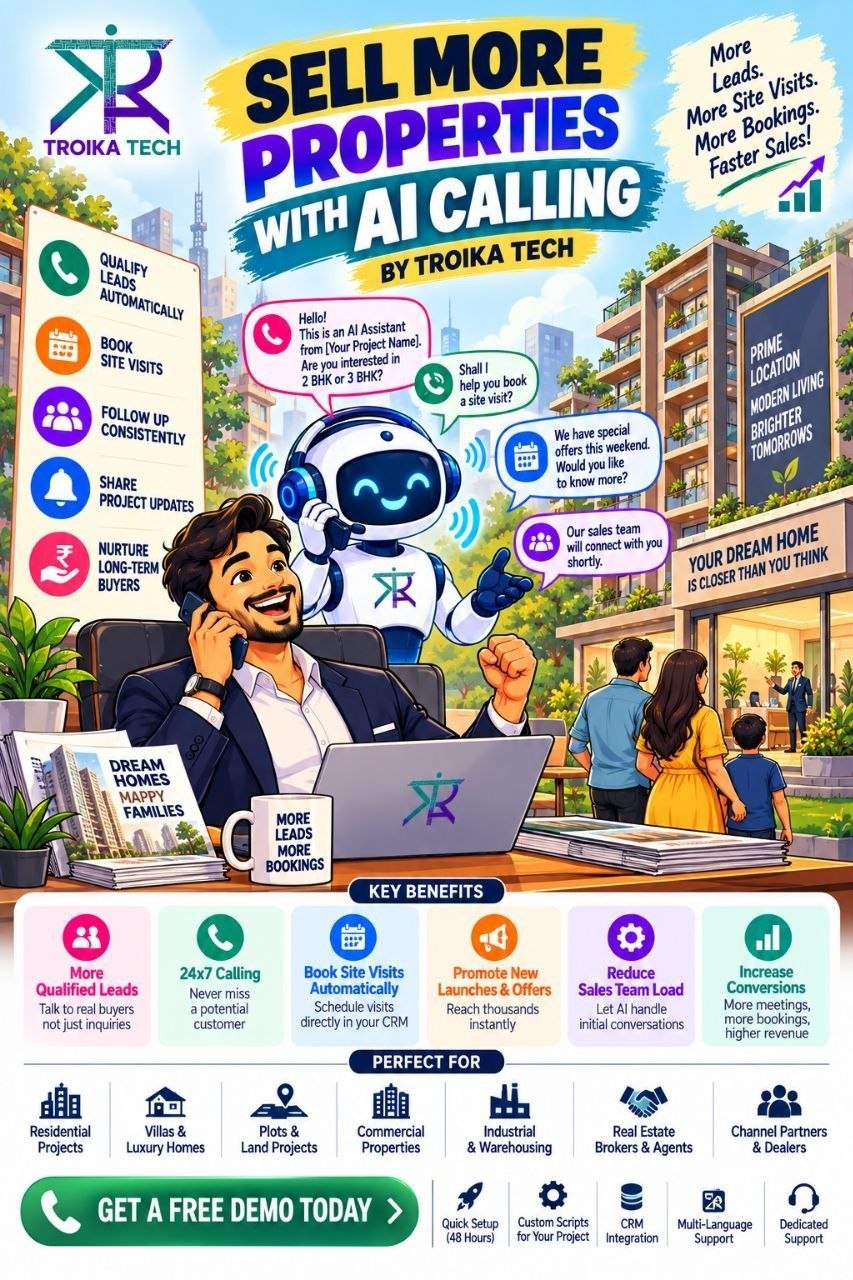
AI can contact thousands of prospects, introduce the project, explain key highlights and identify genuinely interested buyers.
Yes. AI can ask about budget, location, 1/2/3 BHK preference, purchase timeline and buying interest before passing qualified prospects to your sales team.
Yes. Interested buyers can be nurtured and moved towards site visits, meetings and sales discussions.
AI Calling can help engage incoming marketing leads quickly, so valuable enquiries don't remain untouched.
Absolutely. Use AI Calling for pre-launch awareness, expression of interest, launch invitations, offers and database activation.
Yes. Thousands of old enquiries can be re-engaged to discover fresh buying intent.
Fully Managed AI Calling, 9+ Indian languages, custom scripts, reporting, campaign support and per-second billing.
More conversations lead to more qualified leads, more site visits and more opportunities to sell.
AI calling for real estate, in action
Short clips and posts showing how an AI calling agent handles property enquiries, qualifies buyers and books site visits.
Start with the five questions that decide sales priority.
Take your next pre-launch or EOI campaign and write the five questions that determine whether a lead deserves a salesperson's time. Then define the four outcomes: Hot, Warm, Nurture and Not-fit.
If you want to put that workflow into an AI calling campaign, Troika Tech can configure the qualification flow, language handling, CRM handoff and managed calling process, with a stated deployment window of 3–7 days.
Use the 14-day planner